The Hidden Cost of Busy Engineering Organisations
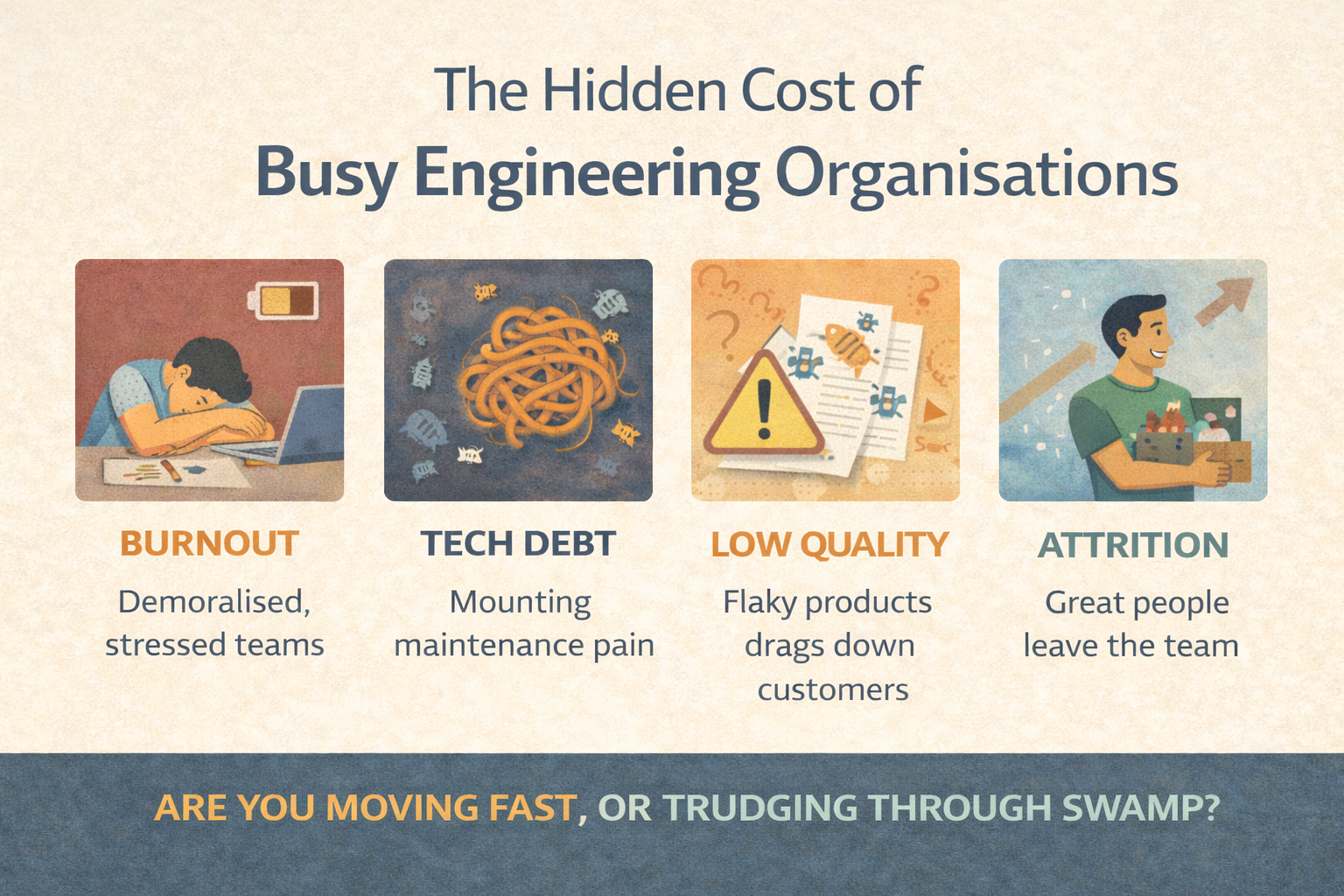
If I ask most engineering leaders how their organisation is performing, the answer usually includes the word "busy." The teams are flat out. Everyone has too much on. The backlog is enormous. We're stretched.
Busy is worn as a badge of honour. It signals effort, dedication, demand. Busy means the organisation is working hard.
Busy is also, very often, the reason nothing gets finished.
The Utilisation Trap
Here is a counterintuitive truth from queuing theory that every engineering leader should understand: high utilisation causes exponential increases in lead time.
This is not opinion. It is mathematics - specifically, the Kingman equation, which models how wait times behave as utilisation approaches 100%.
At 50% utilisation, your average wait time is manageable. At 80%, it roughly doubles. At 90%, it quadruples. At 95%+, the queue becomes effectively infinite. The work piles up faster than it can be processed.
Sound familiar?
When an engineering organisation runs at full capacity - every engineer allocated, every team fully loaded, no slack anywhere - the system starts to behave in precisely this way. New work enters. Existing work slows down. Everything is nominally "in progress." Nothing actually finishes.
This is not a failure of the people. It is a mathematical property of the system.
The WIP Problem
Work in Progress is the silent killer of engineering throughput. Every additional item in flight costs you:
- Context switching overhead. Research consistently shows that switching between tasks carries a significant cognitive penalty - estimates range from 20% to 40% productivity loss per context switch. An engineer juggling three tasks simultaneously is not delivering the equivalent of three parallel streams. They're delivering fractured, error-prone output across all three.
- Coordination cost. More WIP means more dependencies, more hand-off conversations, more "where did we land on this?" meetings. The communication overhead of ten simultaneous projects is not linear - it is closer to quadratic.
- Delay amplification. When everything is in flight, a block in any one piece of work cascades. The engineer waiting for a review picks up something new. Now there are two things blocked. The reviewer, finally free, finds the context has gone cold. Reviews take longer. Rework increases.
The fix is not to tell people to work harder. The fix is to reduce WIP - to make the organisation do fewer things simultaneously, finish them faster, and then start the next thing. This feels wrong to most leaders. It feels like slowing down. It is, in fact, the only way to speed up.
The Invisible Queue
Most engineering organisations obsess over the visible work - the things in their sprint, on their board, in their pipeline. They give almost no attention to the invisible work: the things waiting to start.
The queue before a team is usually much larger than the work the team is aware of. Stakeholder requests that haven't yet been shaped. Ideas in someone's head that will become urgent the moment current work completes. Dependency work that can't start until something upstream finishes. Security reviews, architectural approvals, operational readiness checks - all queued up, all invisible, all consuming calendar time and mental overhead without appearing on any dashboard.
Lead time is measured from when work starts. But the real cycle time - the time from when a customer has a need to when that need is met - includes all of this invisible queue. And that number is almost always shocking when organisations measure it honestly for the first time.
I have worked with teams who believed their lead time was two weeks. When we mapped the full value stream - from the point a need was articulated to the point the customer experienced the outcome - it was four months. The two-week number was real. It just measured the wrong thing.
Busyness Is Not Value
The BVSSH outcome framework has Value as one of its five outcomes for a reason. Value is not the same as output. You can produce enormous output - ship features, close tickets, fill sprints - and deliver very little value.
Busy organisations often confuse activity with progress. The sprint velocity is high. The throughput metrics look healthy. And yet the things that customers care about are not arriving. The strategic initiatives are perpetually three months from complete. The technical debt is growing despite the team working full tilt.
This is the hidden cost of busy: the opportunity cost of not flowing. Every feature delayed by queuing friction is a customer experience degraded, a competitive position eroded, a revenue opportunity lost.
What to Do About It
Three things matter here:
1. Measure flow, not activity. Start tracking cycle time, lead time, and throughput across the system - not just within sprints. Make the invisible queue visible. Know how long it actually takes to go from idea to production.
2. Implement WIP limits. This is the most powerful and most resisted intervention in software engineering. Limit the number of things a team works on simultaneously. Finish before starting. The discomfort is real and short-lived. The improvement in throughput is real and sustained.
3. Protect slack. Counterintuitively, engineering organisations need spare capacity. Not to be lazy - but to respond to the unexpected, to do quality work, to collaborate effectively, to improve the system itself. An organisation running at 100% utilisation cannot improve. There is no time, no energy, and no cognitive space for anything other than keeping up.
Busy is not the same as effective. The most productive engineering organisations I have worked with are not the busiest ones. They are the ones that have learned to flow.

Engineering leader blending strategy, culture, and craft to build high-performing teams and future-ready platforms. I drive transformation through autonomy, continuous improvement, and data-driven excellence - creating environments where people thrive, innovation flourishes, and outcomes matter. Passionate about empowering others and reshaping engineering for impact at scale. Let’s build better, together.