The Platform Engineering Imperative
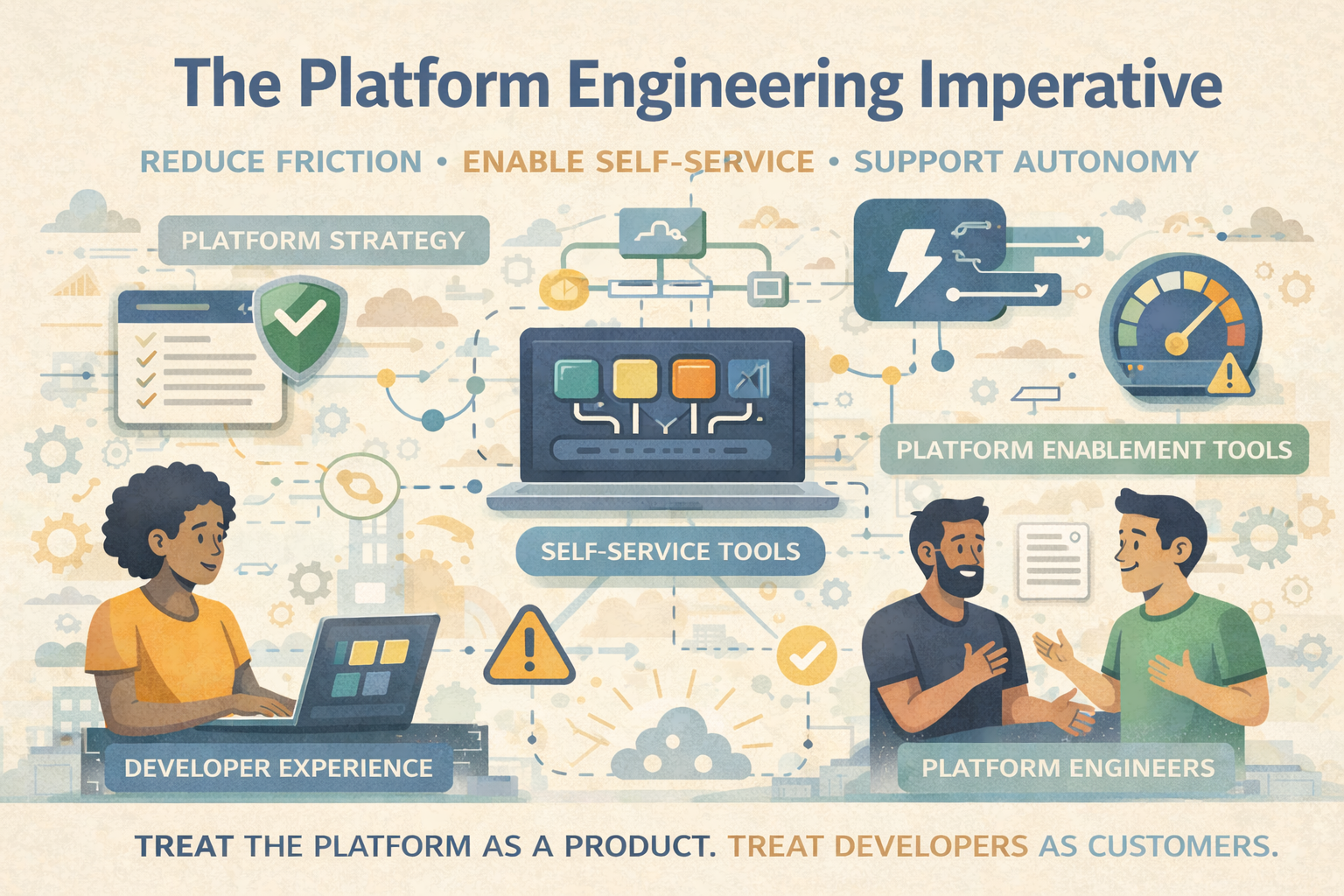
Platform engineering is having a moment. Almost every engineering organisation of meaningful scale is either building an Internal Developer Platform, thinking about building one, or explaining why theirs isn't quite an IDP but is definitely platform-adjacent.
The hype is warranted. The execution is frequently not.
Here's my honest take on what platform engineering is actually for, where most organisations get it wrong, and what good looks like.
The Problem Platform Engineering Solves
Cognitive load.
That's the actual problem. Not "developer experience" in the abstract, not "DevOps toolchain consolidation," not "reducing toil" - though all of those are real. The root cause that platform engineering addresses is the excessive cognitive burden placed on delivery teams.
Every delivery team that has to understand Kubernetes, manage its own observability stack, configure its own deployment pipelines, navigate its own cloud cost controls, and maintain its own security posture is a delivery team spending significant engineering capacity on things that aren't their core purpose.
Matthew Skelton and Manuel Pais are clear on this in Team Topologies: cognitive load is the constraint on team performance. When a delivery team's cognitive load exceeds its capacity, quality falls, velocity falls, and people burn out. The answer is not to hire more senior engineers. The answer is to reduce the load.
A well-designed platform reduces that load by providing a golden path - a set of sensible, secure, observable defaults that any team can follow without becoming an infrastructure expert. It takes complexity and owns it, so delivery teams don't have to.
Platform as a Product
The most common failure mode I see: organisations build platforms for themselves rather than for their users.
The platform team decides what the platform should look like based on their architectural preferences, their operational needs, their security requirements. They build it. They mandate it. Delivery teams use it - resentfully, partially, or not at all.
This is not a platform. This is centralised infrastructure with good branding.
A real platform is a product. It has customers (delivery teams), and those customers have jobs to be done, pain points, and preferences. Understanding those needs requires the same disciplines as any other product: research, iteration, feedback loops, and the humility to accept that your first design will be wrong.
The questions that matter are not "what does the platform need to do?" but "what does a delivery team need to be able to do on their own, safely, without asking for help?" The platform's job is to make that self-service.
Paved roads, not forced paths. The best platforms make the right thing the easy thing. They do not mandate compliance through policy - they make the compliant path so much lower-friction than the alternatives that teams choose it voluntarily. That distinction is the difference between a platform that accelerates delivery and a governance mechanism with a developer portal on top.
The DORA Connection
DORA research is unequivocal: platform capability is a significant predictor of elite software delivery performance. Specifically:
- Teams with good platform tooling deploy more frequently, because the friction cost of deployment is low
- Change Failure Rates are lower in organisations with strong platform observability, because problems are visible before they become incidents
- MTTR is lower where platforms provide standardised incident response tooling and runbooks
- Lead Time for Change is shorter where pipelines are standardised and self-service, rather than requiring bespoke configuration per team
In BVSSH terms: a great platform is a direct enabler of Sooner (faster flow through reduced friction), Safer (security and observability built in, not bolted on), and Happier (engineers doing meaningful work rather than fighting infrastructure).
This is why the DORA research treats platform engineering as a technical capability alongside deployment automation, continuous integration, and version control - not a nice-to-have, but a foundational practice.
What Good Actually Looks Like
I've seen enough platform implementations to have a clear picture of what separates genuinely excellent platforms from expensive vanity projects:
1. Deployment is a minute, not a meeting. A delivery team can take code from merged PR to production in under ten minutes, without raising a ticket or asking for help. This is the benchmark. If your platform doesn't enable this, it is not yet doing its primary job.
2. Everything is observable by default. New services are instrumented automatically. Logs, metrics, and traces are available the moment a service is deployed. Teams don't configure observability - it's there. Alerting has sensible defaults that teams can extend.
3. Security is in the path, not the gate. Security controls are implemented at the platform layer - container scanning, policy enforcement, secrets management, network policy - so that teams don't have to implement them individually and security reviews don't become the last-minute bottleneck before every release.
4. The platform team is the most responsive team in engineering. Nothing kills platform adoption faster than slow response times to the teams who use it. Platform teams that treat their internal customers like enterprise software vendors treat theirs - slow tickets, long roadmaps, infrequent releases - will find their platform bypassed within a year.
5. Usage is voluntary and growing. If teams are only using the platform because they're mandated to, it isn't a good platform. Usage should grow because the platform genuinely makes things easier. Voluntary adoption is the only real success metric.
The Uncomfortable Truth
Platform engineering done well requires long-term investment, product discipline, and organisational patience. It will not improve your DORA metrics in six weeks. It will not make your next quarterly board update look better.
But done well, over twelve to eighteen months, it is one of the highest-leverage investments an engineering organisation can make. The cognitive load it removes from delivery teams compounds across every team, every quarter, every initiative. The capability it enables accumulates.
The organisations that invested seriously in platform engineering five years ago are now the ones shipping daily, recovering in minutes, and onboarding new engineers to production capability in days rather than months.
The organisations that treated it as a cost centre or an IT consolidation project are still configuring Kubernetes manually in 2026.
The choice is structural. Make it deliberately.

Engineering leader blending strategy, culture, and craft to build high-performing teams and future-ready platforms. I drive transformation through autonomy, continuous improvement, and data-driven excellence - creating environments where people thrive, innovation flourishes, and outcomes matter. Passionate about empowering others and reshaping engineering for impact at scale. Let’s build better, together.