What the DORA 2025 Report Actually Tells Us
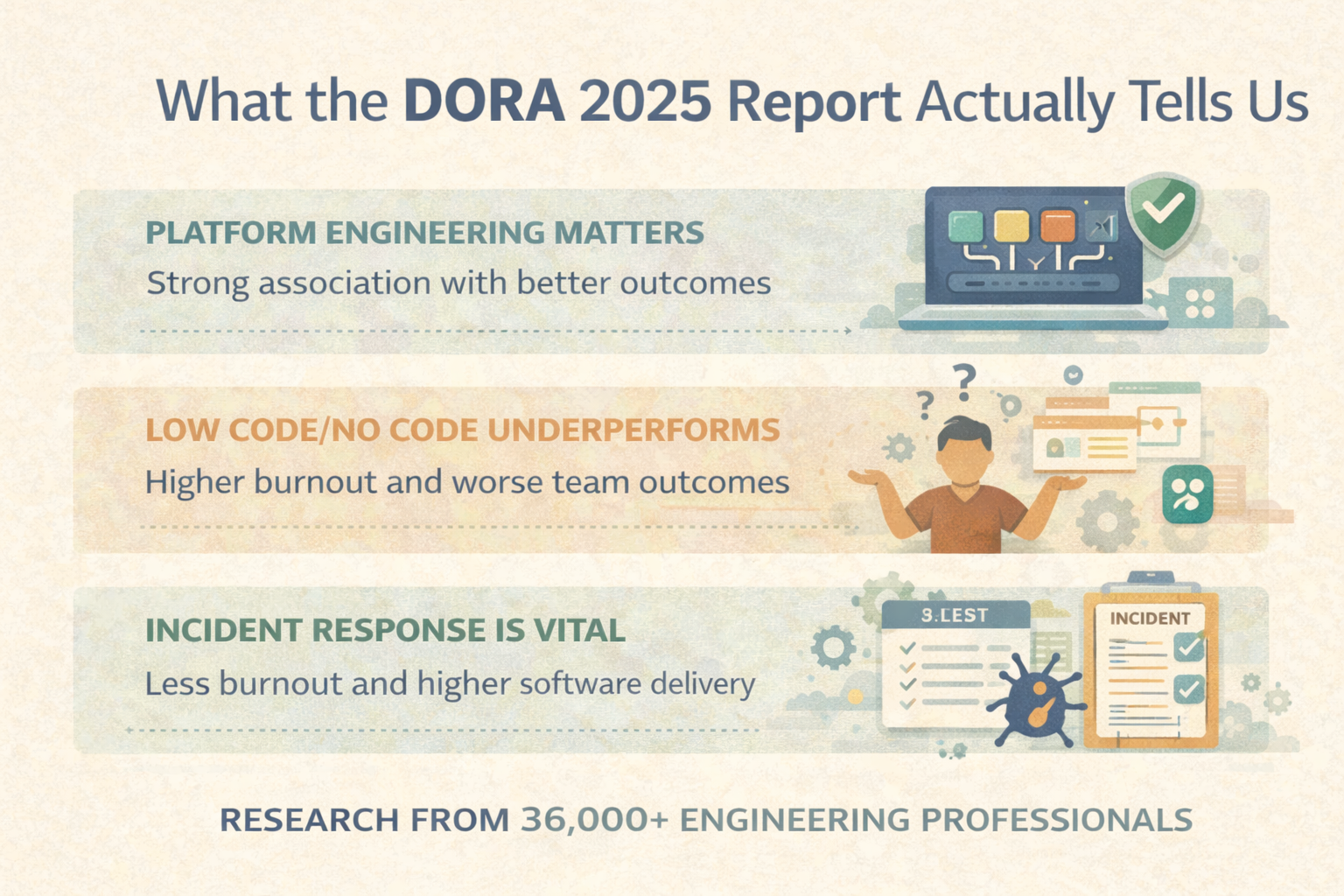
The DORA 2025 report is out. It's worth reading carefully - not for the headline numbers, but for what's hiding beneath them.
Here's my read.
The Headline: AI Is Changing the Numbers
The 2025 report shows that organisations with meaningful AI adoption in their development workflows are reporting better scores across the four key DORA metrics. More frequent deployments. Shorter lead times. Lower change failure rates in some cohorts.
This is the finding that will dominate the conference circuit for the next twelve months. Leaders will ask their engineering teams why they aren't showing similar improvements. Tool vendors will cite the report in their pitches.
Most of them will be drawing the wrong conclusion.
The Correlation Trap
The organisations seeing improved DORA metrics from AI adoption are, overwhelmingly, the organisations that were already in the high or elite performance bands. They had capable deployment pipelines before AI. They had good test automation before AI. They had engineering cultures that prioritised quality and flow before AI.
AI made those things faster. It didn't create them.
The organisations in the medium or low performance bands - the ones where deployment is an event, where test coverage is thin, where technical debt is structural - are not seeing equivalent gains. In some cases, AI tooling is making things worse: generating more code, faster, into systems without the quality infrastructure to validate it safely.
This is not a knock on AI. It is a statement about readiness. AI is an amplifier. It amplifies what's already there.
The Finding That Matters More
Buried in the 2025 report, consistent with every year of DORA research: organisational culture remains the most powerful predictor of software delivery performance.
Specifically, Westrum's model of organisational culture - generative, bureaucratic, or pathological - continues to be the single strongest correlate with elite performance. Organisations with generative cultures, where information flows freely, failure is treated as a learning opportunity, and responsibility is shared, consistently outperform on every DORA metric.
This finding has been consistent since the first DORA report. It is consistently underacted on.
It's easier to buy an AI coding tool than to change how your leadership team responds to failure. It's easier to instrument DORA metrics than to create the psychological safety that allows teams to surface problems honestly. Tool purchases show up in budgets. Culture change is harder to account for and harder to attribute.
So organisations buy the tools and neglect the culture. The DORA metrics improve marginally. The elite organisations - who have both - pull further ahead.
The Elite Performance Gap Is Widening
One of the more sobering findings in the 2025 data: the gap between elite performers and the rest continues to grow.
Elite performers are not improving incrementally. They are compounding. Each improvement in deployment frequency makes the next improvement easier. Each reduction in lead time creates space for better quality work. Each improvement in change failure rate reduces the recovery burden that previously consumed engineering capacity. The flywheel spins faster.
For organisations in the low or medium bands, the gap is not closing. The distance to elite feels more daunting, not less, than it did five years ago.
I think this is the real warning in the 2025 report. Not "look how much AI helps" - but "look how much further behind you are if you haven't addressed the fundamentals."
What It Means for 2026
My read on the implications:
Culture first, tools second. If your organisation does not have a generative culture - where problems are surfaced, failure is learned from, and engineers have genuine agency - no amount of tooling will produce elite outcomes. The investment in culture is not soft. It is the primary determinant of hard performance numbers.
AI accelerates the capable. If you have strong foundations - good test automation, observable systems, a working deployment pipeline, low WIP - AI tooling will genuinely accelerate you. If you don't, it will mostly generate more work in your queues.
The fundamentals still win. Deployment frequency, lead time, change failure rate, and MTTR are still the right things to measure. Not because DORA says so - because they are genuine indicators of system health. The 2025 report does not invalidate them. It contextualises them.
The elite are pulling away. If your organisation is not already in the high or elite bands, the urgency to address the underlying constraints - architectural, cultural, structural - has never been higher.
The DORA report is not a celebration of where we are. It is a map of the distance still to travel.

Engineering leader blending strategy, culture, and craft to build high-performing teams and future-ready platforms. I drive transformation through autonomy, continuous improvement, and data-driven excellence - creating environments where people thrive, innovation flourishes, and outcomes matter. Passionate about empowering others and reshaping engineering for impact at scale. Let’s build better, together.