In 1949, Harry Harlow gave a group of rhesus monkeys a mechanical puzzle to solve. They weren't rewarded for solving it - there was no food, no approval, no extrinsic incentive. They solved it anyway, enthusiastically and repeatedly, because they found it intrinsically interesting. When Harlow introduced food as a reward, performance declined. He filed this away as anomalous and moved on. Daniel Pink spent a career asking why.
Drive is the answer. Drawing on four decades of research in behavioural science, Pink dismantles the assumption that underlies most organisational incentive design - that people work harder and better when you pay them more for performance. For complex, creative work, the evidence suggests the opposite: external rewards narrow focus, reduce intrinsic motivation, and produce worse outcomes. For engineers, this is not a fringe finding. It is one of the most well-replicated results in occupational psychology.
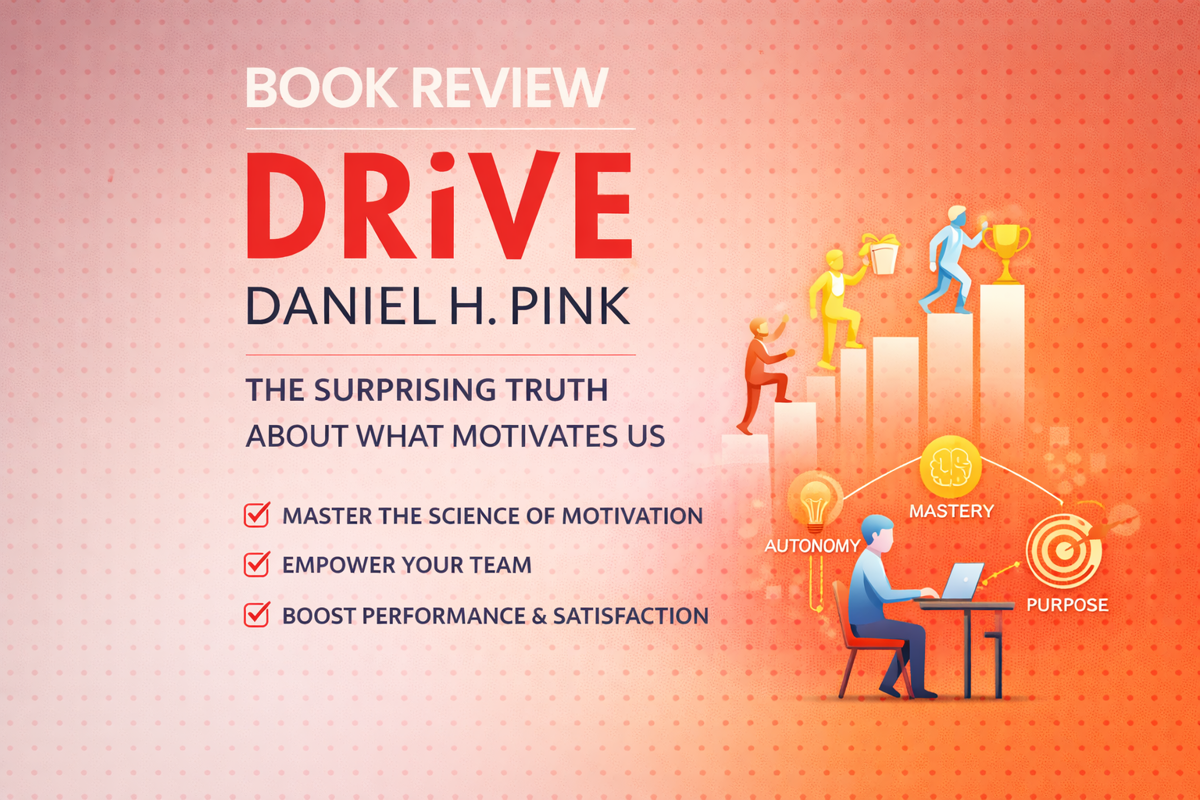
The book argues for a different operating system for motivation, built on three elements: autonomy, mastery, and purpose. This is not a feel-good alternative to rigorous performance management. It is what the science actually says produces sustained high performance in knowledge work.
Engineering organisations spend enormous energy on incentive design - performance bonuses, stack rankings, promotion criteria, recognition schemes - and often wonder why engagement remains mediocre and turnover stays high. Pink offers an explanation that most HR frameworks struggle to accommodate: for the kind of work engineers do, the standard model of motivation is simply wrong.
The research Pink draws on distinguishes between two types of tasks. Algorithmic tasks - follow a defined process to a defined outcome - respond positively to extrinsic incentives. Heuristic tasks - creative work where there is no predefined process, where the challenge is to figure out what to do as much as how to do it - respond negatively to the same incentives. They suppress curiosity, reduce exploration, and narrow the cognitive engagement that makes the work good.
This matters enormously for engineering leaders. Most meaningful engineering work is heuristic. If your incentive structures are designed for algorithmic work - if they are optimising for output metrics, if they are narrowing focus through individual performance bonuses - they may be actively undermining the performance you're trying to create.
The most counterintuitive and most important finding in the book: rewarding people for doing something they already want to do often makes them want to do it less. Researchers call this the overjustification effect. When you introduce an external reward for an intrinsically motivated behaviour, the person shifts their locus of causality from internal to external. They go from "I do this because I find it interesting" to "I do this because I get paid for it." When the reward disappears, so does the motivation.
For engineering leaders, the implication is significant. Intrinsic motivation - curiosity, craft, the satisfaction of solving a hard problem - is the most powerful and most durable source of high performance. If your management practices are systematically replacing it with extrinsic reward, you are trading long-term engagement for short-term compliance.
Pink's research on autonomy is specific: it is not merely having some discretion at the margins of your work. It is meaningful control over the four dimensions of work - what you do, how you do it, when you do it, and with whom you do it. Organisations that provide genuine autonomy across these dimensions - not as a policy, but as a lived daily reality - outperform those that provide managed autonomy on selective metrics.
The best engineering organisations already understand this intuitively. They hire people they trust, give them problems to solve rather than solutions to implement, and get out of the way. The worst ones dress command-and-control in the language of empowerment - giving teams nominal ownership while maintaining approval gates, technology mandates, and detailed delivery oversight that leave no meaningful autonomy at all.
Mastery - the desire to get better at things that matter - is one of the most powerful drivers of sustained engagement. People who are learning, growing, and developing genuine expertise are almost universally more engaged, more creative, and more likely to stay. People who feel they've plateaued - whose role has become routine, whose skill development has stalled - disengage and leave, often to competitors.
Most organisations underinvest in mastery systematically. Learning budgets are the first things cut. Mentoring structures are informal and unreliable. Senior engineers' time is consumed by delivery and meetings rather than knowledge transfer. The cost is invisible until engineers start leaving, at which point the organisation rediscovers that the real cost of turnover is the lost expertise, not the recruitment fee.
Pink's third element - purpose - has been widely misread as a call for better storytelling. Leaders are encouraged to "help people understand the why," as if the problem is one of messaging rather than reality. This misses the point.
Purpose, in Pink's research, means that the work connects to something larger than the task itself - that there is a genuine, observable link between what someone does and an outcome that matters to them and to others. You cannot manufacture this connection through all-hands presentations. It either exists in the design of the work, or it doesn't.
For engineering leaders, the question is not "how do we communicate purpose?" but "have we structured work so that engineers can see the impact of what they build?" Feature teams with direct customer contact, outcome-oriented OKRs visible to everyone, incident retrospectives that close the loop between engineering decisions and reliability outcomes - these are purpose as structural design, not purpose as messaging.
Pink concludes with a practical taxonomy. "If-then" rewards - if you hit this target, then you receive this bonus - are effective for simple, clearly defined tasks with a specific correct answer. They are ineffective or counterproductive for complex, creative, judgment-intensive work.
"Now that" rewards - unexpected, non-contingent recognition after genuinely good work - avoid the overjustification effect because they don't change the person's understanding of why they did the work. They are experienced as information ("you did something excellent") rather than control ("do this to receive that"). The practical implication is not to stop recognising good performance, but to change the structure of how you do it.
Audit your team's meaningful work through the autonomy lens: do people genuinely control what they work on, how they approach it, their own schedule, and who they collaborate with? Or is the autonomy mostly rhetorical?
Think about your highest-performing engineers. What motivates them? Is it the performance bonus, or is it something else? What would happen to their performance if you removed the bonus and replaced that resource with additional learning time?
When was the last time you had a conversation with a team member about their mastery trajectory - not their performance review, but what they are genuinely trying to become better at? What would need to change to make that a regular practice?
Which of your engineering practices most actively suppress autonomy? Which require unnecessary approval, provide insufficient ownership, or prescribe process where judgement would be better?
What do your engineers do on personal projects, in hackathons, in their own time? What does that tell you about what they find intrinsically engaging - and how different is it from what they do at work?
Audit your current performance incentive design against Pink's framework. Which elements reward algorithmic compliance? Which reward creative, heuristic contribution? Redesign the ones that are narrowing the behaviour you actually want.
Have a mastery conversation with each direct report this month - not a performance conversation. Ask what they're trying to get better at, what's getting in the way, and what support would accelerate it.
Reduce one approval process. Find a decision that currently requires your sign-off that could reasonably be made by the person doing the work. Remove yourself from it. Watch what happens.
Design one "now that" recognition this week - a specific, unexpected, genuine acknowledgement of excellent work, not tied to any target or incentive scheme. Notice how it lands differently.
Survey your team's purpose connection - not with a satisfaction survey, but with a direct question: "Can you tell me exactly how the work you did last month affected a customer, a user, or an outcome that matters to you?" If they can't, that's a structural problem to solve.
"The secret to high performance and satisfaction - at work, at school, and at home - is the deeply human need to direct our own lives, to learn and create new things, and to do better by ourselves and our world."
- Daniel H. Pink