Patrick Lencioni told a story about a technology company in chaos. The executive team was smart, experienced, and individually impressive. They were also dysfunctional in every meaningful sense - avoiding conflict, protecting turf, prioritising individual success over collective results. The company was failing not despite its talent, but because of how its talent was organised.
The Five Dysfunctions of a Team is written as a business fable, which puts some serious readers off. Ignore that instinct. The fable format is deliberate - it makes the dynamics observable rather than theoretical. You will recognise people you've worked with in every character. You may recognise yourself.
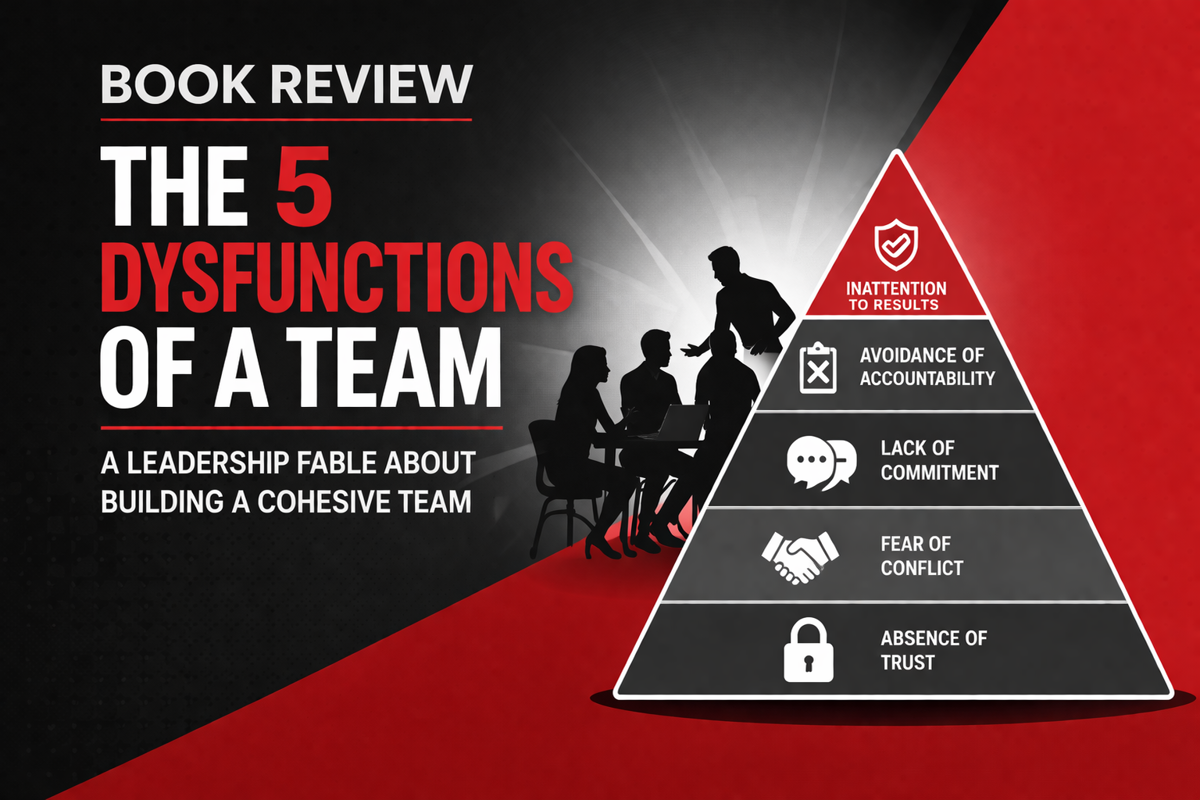
The model at the heart of the book is a pyramid of dysfunction: absence of trust at the base, feeding fear of conflict, then lack of commitment, then avoidance of accountability, then inattention to results at the top. Each dysfunction enables the next. And the whole structure is far more common than most leadership teams are comfortable admitting.
Most organisations treat teamwork as a cultural aspiration rather than a structural discipline. They hire good people, assume collaboration will follow, and then wonder why meetings are performative, decisions get relitigated, and accountability conversations never happen. Lencioni makes the uncomfortable argument that teams are not the default - dysfunction is the default. Teams require deliberate construction.
For engineering leaders, this book is particularly confronting. The technical culture often attracts people who prefer individual contribution, are conflict-averse in interpersonal situations (while being openly combative about technical choices), and find the ambiguity of team dynamics genuinely uncomfortable. The result is organisations full of clever people who cannot agree on anything.
The five dysfunctions model gives you a language and a diagnostic framework. It won't fix your team on its own. But it will help you see clearly what is actually happening beneath the surface of your leadership team's polished meetings.
Lencioni's definition of trust is specific and important: vulnerability-based trust. This is not the trust that comes from working alongside someone for years. It is the trust that allows you to say "I was wrong," "I don't know," "I need help," and "I'm sorry" - without calculation and without fear.
Most leadership teams operate at a level below this. They've built a version of professional respect that functions as long as performance is good and ego is protected. The moment someone needs to admit weakness or make themselves genuinely vulnerable, the whole edifice reveals itself to be something much more fragile than trust.
Vulnerability-based trust is built through shared history, honest conversation, and repeated experiences of vulnerability being safe. It cannot be mandated. But it can be modelled - and it must be modelled by the leader first.
Teams without trust cannot have productive conflict. Instead, they have artificial harmony: polished agreement in the meeting room, lobbying and politics in the corridor. Every genuinely difficult decision gets made slowly, badly, or not at all.
Lencioni distinguishes between ideological conflict - the passionate, unfiltered debate of ideas - and interpersonal conflict - the kind that gets personal and political. Great teams embrace the former and almost eliminate the latter. Struggling teams suppress the former entirely, which creates the conditions for the latter.
If your team's meetings are consistently pleasant, something is wrong. Real problems require real disagreement. A culture that can't sustain that kind of friction cannot solve hard problems.
One of the most practically useful observations in the book: commitment doesn't mean everyone agreed. It means everyone understood the debate, had their perspective heard, and chose to support the decision.
Teams that confuse commitment with consensus will rarely commit to anything. The need for everyone to agree creates an incentive for vague, hedged decisions that nobody objects to because nobody is really bound by them. Real commitment requires a clear decision and the willingness to hold each other to it.
This is where the previous dysfunction (absence of conflict) becomes lethal. Without genuine debate, there is no real commitment - only nominal agreement that dissolves the moment circumstances change.
In a functional team, accountability doesn't flow primarily from the leader. It flows from peers. Team members hold each other to agreed standards not because the leader is watching, but because they care about the collective result and each other's performance.
Most teams lack this. When accountability conversations are uncomfortable, people avoid them and wait for the leader to step in. The leader does, reinforcing the dynamic that accountability is the leader's job. Eventually the leader is managing everything directly, and the team is just a group of people reporting to the same person.
Lencioni argues that peer accountability is only possible when there are clear commitments to hold people to (commitment), and clear standards that everyone cares about (results). Pull out any link in the chain and accountability collapses.
The final dysfunction - inattention to results - happens when individuals or functions prioritise their own metrics, reputation, or career advancement over the team's shared objectives. It is rational at the individual level and catastrophic at the system level.
The remedy is not to eliminate individual goals. It is to create a collective scoreboard - a small set of measures that the whole team owns, that only succeed when everyone contributes, and that are visible enough to create genuine accountability. When people can see the collective result clearly, they become far more willing to subordinate individual preferences to it.
Think about the last genuinely difficult decision your leadership team made. Was the debate real? Did people say what they actually thought, or what they thought would land well?
When someone on your team underperforms, who has the conversation? If the answer is always "their manager," you have an accountability gap that no performance review process will fix.
What would your team's collective result look like? Not individual OKRs. A single scoreboard. If you struggle to define it, that's the first problem.
How does conflict manifest in your team? If it disappears in the room and reappears in one-to-ones with you, you have artificial harmony - which is just managed conflict, not resolved conflict.
Who on your team couldn't admit a mistake to their peers without it feeling professionally significant? What would need to change for that to feel safe?
Run a personal history exercise in your next offsite. Each person shares three things about their background that others wouldn't know. It sounds trivial. The vulnerability it creates is not.
Name a recent decision where commitment broke down. Was it because people weren't heard, because the decision was genuinely unclear, or because there was never a real commitment in the first place? Each has a different fix.
Look at your team meeting agenda. How much of it is performance reporting versus actual debate? If it's mostly reporting, your team isn't a decision-making body - it's an audience.
Identify the accountability conversation your team most needs to have and hasn't had. Have it this week. If you need to start it, start it. Model what you want to see.
Define the team's collective scoreboard - two or three measures that belong to the group, not individuals. Make it visible. Review it every week.
"Not finance. Not strategy. Not technology. It is teamwork that remains the ultimate competitive advantage, both because it is so powerful and so rare."
- Patrick Lencioni