← All Book Reviews
Book Review
Flight Levels: The Coordination Book Most Organisations Don’t Realise They Need
Ragan McGill
Ragan McGill
Most books about improving engineering organisations focus on teams.
They talk about agile practices, engineering excellence, DevOps, autonomy. They assume that if teams improve, the organisation improves.
Flight Levels: Leading Organizations with Business Agility starts from a different premise.
Teams are rarely the problem.
The system is.
And more specifically, the missing layer between strategy and execution is.
Most organisations are structured around two conversations:
What is missing is the conversation in between:
How does work actually move across the organisation?
This is where most delivery problems live.
Flight Levels names this gap clearly.
And then gives you a way to see it.
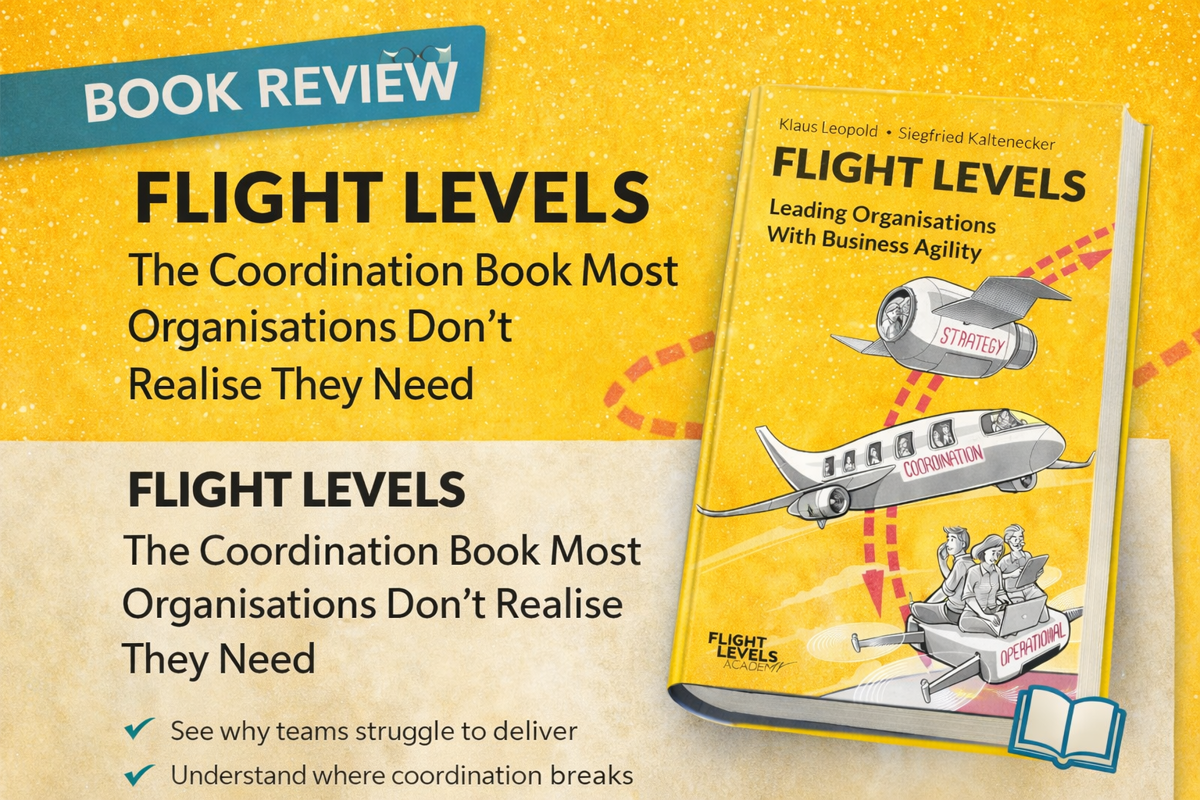
The book introduces three “flight levels”:
Flight Level 3, Strategy
Where direction, priorities, and investment decisions are made
Flight Level 2, Coordination
Where work is aligned, sequenced, and managed across teams
Flight Level 1, Operations
Where teams execute and deliver
These are not new layers.
They already exist in every organisation.
The insight is that performance depends on how well they interact.
Most organisations have strong opinions about Level 1.
Some have clarity at Level 3.
Almost none have designed Level 2.
The book’s central argument is simple and difficult:
You cannot improve delivery by optimising teams alone.
Because teams are not where most delay lives.
Delay lives in:
All of which sit between teams.
This is why so many transformations stall.
They improve how teams work, but leave the system unchanged.
Most organisations treat coordination as overhead.
Something that “just happens”.
In reality, it is one of the most critical capabilities in the system.
Without it:
With it:
The absence of coordination is not neutral.
It is actively harmful.
One of the strongest ideas in the book is deceptively simple:
Make the system visible.
Not just team boards.
But:
When organisations do this properly, the reaction is consistent.
Surprise.
Then discomfort.
Then clarity.
Because the amount of waiting in most systems is far higher than anyone expects.
Flight Levels repeatedly returns to a core constraint:
Work in progress.
Organisations start too much work.
Which leads to:
The solution is not better prioritisation alone.
It is creating focus at a system level.
Which requires trade-offs that many organisations avoid.
The book shifts attention away from activity and towards flow.
Not:
But:
This aligns closely with modern thinking around DORA and flow metrics.
But Flight Levels places it at an organisational level, not just a team level.
The most important implication:
You do not fix flow by asking teams to go faster.
You fix flow by:
This requires leadership.
Not more effort from teams.
Where the book becomes practical is in the five activities it introduces.
These are not steps.
They are ongoing behaviours.
Make work and dependencies visible across the system.
Limit work in progress and align around fewer priorities.
Create structured ways for coordination and decision making.
Understand how work flows, not just how much is done.
Continuously evolve the system based on what you see.
Individually, these are straightforward.
Collectively, they are transformative.
Because they shift the organisation from managing activity to managing flow.
It is not trying to be comprehensive.
It is trying to change how you see.
And it succeeds.
The simplicity of the model can be misleading.
It is easy to:
The book gives you the lens.
It does not do the hard work for you.
Where does coordination actually happen in your organisation? Is it designed, or accidental?
How much of your work is actively moving right now, versus waiting?
If you visualised work across teams today, what would surprise you?
Are your strategic priorities aligned with your system’s capacity?
Who owns flow across the organisation?
Map work across teams, not just within them. Identify where work is waiting.
List your current initiatives. How many are active? Which ones could you stop?
Identify your biggest dependency bottleneck. What causes it, and who owns it?
Observe how coordination happens. Is it structured, or reactive?
Ask one uncomfortable question:
Where is work actually getting stuck?
Most organisations do not lack capability.
They lack clarity.
Flight Levels provides that clarity.
Not by adding complexity.
But by revealing the system that was already there.