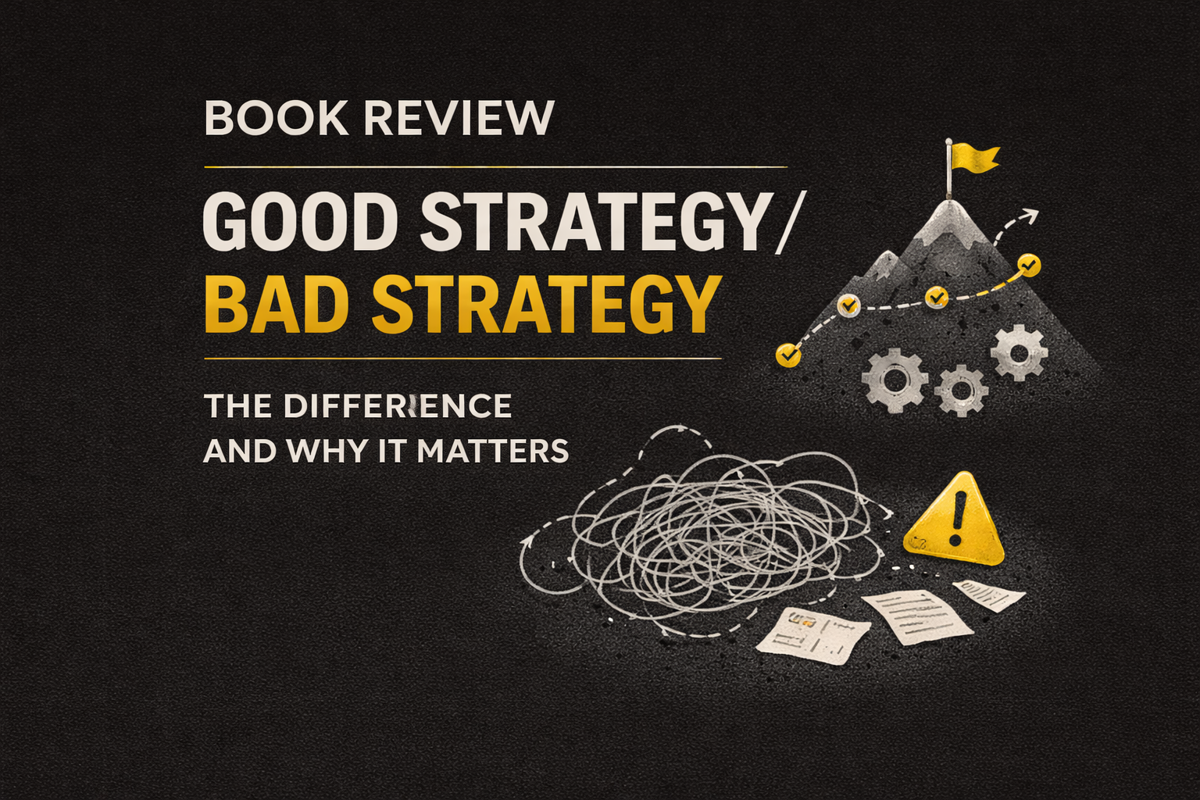
Most organisations do not have a strategy. They have a vision, a set of values, a collection of goals, and a list of initiatives with delivery owners. They call this a strategy. Richard Rumelt calls it "bad strategy" - and his critique is so precise, and the examples so recognisable, that reading this book is a mildly uncomfortable experience for anyone who has ever been party to a strategy process.
Good Strategy Bad Strategy is not a framework for writing strategy documents. It is a demolition of the strategic practices that have colonised most large organisations - the meaningless mission statements, the aspirational goals without diagnosis, the action plans that imply a strategy exists when no coherent thinking underlies them. And then, with equal rigour and specificity, it is an account of what genuine strategy actually looks like and how to develop it.
The technology industry has a particular variant of strategy failure. Organisations confuse product vision with strategy. They confuse OKRs with strategy. They confuse a well-presented slide deck with a coherent account of how they intend to prevail in a competitive landscape. The consequences - resources spread thin, teams pulling in subtly different directions, investments that cannot be explained against a coherent logic - are everywhere.
For engineering leaders, this book matters because technology strategy and product strategy are not separate from organisational strategy. The decisions about what to build, how to architect it, where to invest in platform capability, and where to partner rather than build in-house are all strategic decisions - and they require the same rigorous diagnosis and coherent choice-making that Rumelt demands of business strategy.
Rumelt's most important contribution is naming the phenomenon of bad strategy clearly enough that it can be recognised. Bad strategy is not confusion or uncertainty - it is the presence of strategy-shaped language that has no strategic content.
The hallmarks: fluff (high-sounding words that communicate nothing specific), failure to face the challenge (goals that avoid naming the actual problem), mistaking goals for strategy (announcing "we will grow by 20%" as if it were a plan), and bad strategic objectives (lists of things to do with no account of how they connect). The last two are epidemic in technology organisations that have adopted OKR frameworks without developing the underlying strategic thinking that gives OKRs their meaning.
Against the chaos of bad strategy, Rumelt offers a clean structure. The kernel of a good strategy has three components: a diagnosis that defines and simplifies the challenge, a guiding policy that channels action in response to that challenge, and coherent actions that implement the guiding policy with coordinated force.
The diagnosis is the part that is almost universally missing. A diagnosis names the specific challenge being addressed - the obstacle, the constraint, the asymmetry - with enough specificity that it could be contested. "We need to grow faster" is not a diagnosis. "Our sales cycle is five times longer than our nearest competitor because our product requires six months of configuration before value is visible" is a diagnosis. From the latter, a guiding policy and coherent actions can be derived. From the former, only goals can be written.
Good strategy does not spread resources evenly across all opportunities. It concentrates force at the point where it can produce the greatest effect - the pivotal point where a focused intervention changes the dynamics of the whole system.
For engineering organisations, the question of leverage is fundamental to every investment decision. Where is the constraint in the delivery system that, if addressed, would unlock performance gains across the whole? Which capability gap is limiting the effectiveness of everything else? Rumelt's framework demands that strategy identify these levers explicitly - and that resource allocation follow the logic of leverage rather than the logic of political balance.
Rumelt's account of competitive advantage is grounded in asymmetry: what can your organisation do that others cannot, or find more costly or difficult? This might be technical capability, customer relationships, data, speed of iteration, or regulatory position. Whatever it is, the strategic task is to identify the asymmetry, amplify it, and build actions that extend and exploit it.
For technology organisations, this requires honest assessment of where genuine advantage lies. Not where you would like it to lie. Not where the market narrative says it lies. Where, based on evidence, you can do something that compounds over time and that competitors would struggle to replicate. That is the foundation on which coherent strategy can be built.
One of Rumelt's practical contributions is the distinction between aspirational goals and proximate objectives. Aspirational goals are fine as inspiration. They are not strategy. A proximate objective is a goal that is within the realm of the achievable given current resources and capabilities - something that, when achieved, changes the position and opens the path to the next objective.
This matters enormously for engineering strategy. Long-horizon goals - "be the platform of record for enterprise engineering intelligence" - cannot be acted on. Proximate objectives - "achieve sub-ten-minute pipeline runs for 80% of teams by Q3" - can be designed against, tracked, and delivered. Good strategy chains proximate objectives together in a coherent sequence toward the larger ambition.
Read your organisation's strategy document and ask: is there a diagnosis here? If you cannot find a specific, falsifiable description of the challenge being addressed, you do not have a strategy - you have a goals document.
"We will be the leading provider of X" is a goal. "Because our customers currently experience Y problem and we have a structural advantage in solving it through Z, we will focus our resources on becoming the definitive solution to Y in the X market" is the beginning of a strategy. Only one of these gives your teams something to orient against.
The question "what are we not going to do?" is one of the most important questions a strategy can answer. An organisation that tries to do everything well is a strategy-free organisation.
Your OKRs are not a substitute for a strategy. They are useful for aligning execution once a strategy exists. Without the underlying strategic logic, OKRs are just goals with keyresults - and goals without diagnosis are wishes.
The leaders most resistant to Rumelt's framework are often the ones most invested in the current strategy process - because genuine strategic thinking requires honesty about challenges that strategic theatre is designed to avoid.
Diagnose your actual challenge. Write one paragraph - not a vision, not a goal - that names the specific problem your organisation or team faces. Make it falsifiable. Make it specific enough that someone could disagree with it. If you can't write it, you don't have the diagnosis yet.
Audit your current strategy against the bad strategy checklist. Fluff? Goals mistaken for strategy? Actions that don't connect coherently? Be honest about what you find.
Identify your three highest-leverage opportunities. Where would focused investment produce disproportionate return? Where is the constraint that, if removed, would change the performance of everything downstream?
Map your coherent actions. For each major initiative, ask: what guiding policy does this implement? If you cannot answer, the initiative may be disconnected from the strategy - or the strategy may not exist in the form you assumed.
Have the asymmetry conversation. Bring your leadership team together and ask: what can we do that our competitors genuinely cannot, or find significantly harder? Build your strategic logic from the honest answer.
"The core of strategy work is always the same: discovering the critical factors in a situation and designing a way of coordinating and focusing actions to deal with those factors."
- Richard Rumelt