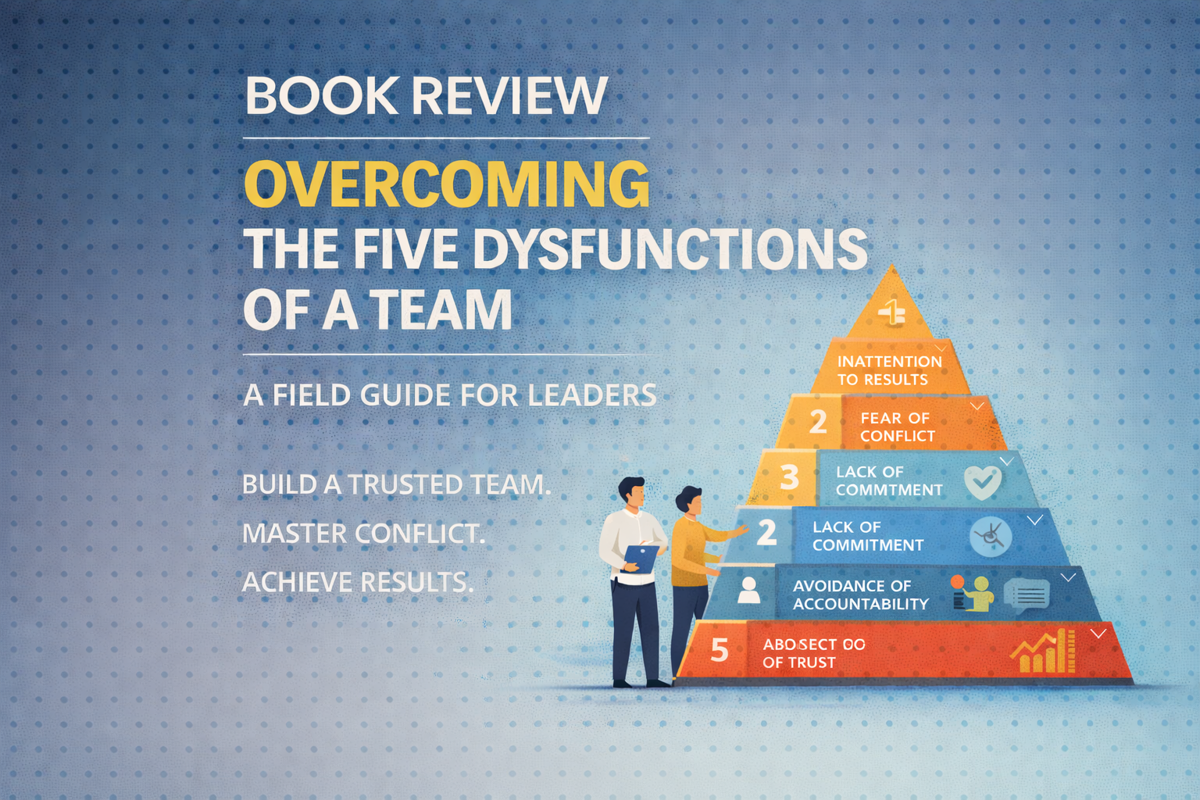
The Five Dysfunctions of a Team diagnoses the problem. This book tells you how to fix it. Where the original fable makes the dysfunctions visible through story, Overcoming the Five Dysfunctions is a practical guide - a structured set of tools, exercises, and interventions for leaders working with real teams in real organisations who want to move from understanding the model to applying it.
Lencioni is explicit about the purpose: this is a field guide, not a sequel. It assumes you've read the original (if you haven't, start there), accepts the diagnostic framework, and focuses entirely on the question of what to actually do. How do you build vulnerability-based trust in a team that doesn't have it? How do you create a culture of productive conflict when the default is artificial harmony? How do you get genuine commitment from people who are used to saying yes without meaning it?
The answers are more specific and more operational than most leadership books are willing to be. Some of the exercises feel uncomfortable. That discomfort is deliberate - it is a signal that you are doing the work that actually matters.
The gap between knowing what's wrong with a team and being able to fix it is vast - and most leadership development resources live entirely on the "knowing" side of that gap. They offer frameworks, models, and assessments, but stop short of the messy, uncomfortable, specific work of actually changing team behaviour.
Lencioni crosses that gap. He gives you specific interventions, sequenced by dysfunction, with guidance on how to facilitate them, what resistance to expect, and how to sustain the progress you make. For engineering leaders who have used the five dysfunctions model as a diagnostic - who have named the problems in their team and then stalled on what to do about them - this book is the practical companion they needed.
It is also honest about the limits of the approach: these interventions take time, require consistent follow-through, and will not work unless the leader is genuinely willing to model the vulnerability they're asking for. There are no shortcuts. But the path is clearer here than in almost any other resource on team development.
The foundational intervention for absence of trust is the personal histories exercise - team members share a series of personal facts about their backgrounds that colleagues wouldn't typically know. The topics start non-threatening and progressively require more openness. The result is almost always a shift in how team members relate to each other - not because they've resolved a conflict, but because they've become human to one another in a way that the professional context typically prevents.
This sounds too simple to be transformative. In practice it consistently is. The reason is that vulnerability-based trust does not come from time alone - many teams work together for years without it. It comes from shared experiences of genuine disclosure met with genuine acceptance. The exercise creates those experiences deliberately. Once the template exists, people know it's safe. And they build on it.
Teams that want to improve their capacity for healthy conflict cannot simply declare an intention to be more honest. They need an explicit agreement - a team conflict norms statement - that defines what productive conflict looks like, what behaviour is expected, and what each member commits to when disagreement arises.
Lencioni provides a framework for developing this as a team. The process of agreeing on the norms is as valuable as the norms themselves - because it requires the team to have an honest, sometimes uncomfortable conversation about how they currently handle conflict and how they want to handle it differently. Teams that have done this work can point to a shared agreement when a conversation gets heated. They have a reference point that belongs to all of them.
One of the most immediately practical tools in the book is the commitment and review practice at the end of meetings. Before closing any meeting where decisions are made, the team reviews each decision explicitly: is everyone clear on what was decided? Does everyone commit to it - not necessarily agreeing with it, but supporting it?
This practice sounds administrative. What it actually does is surface the ambiguity and unexpressed reservations that, left unaddressed, produce the apparent commitment that dissolves in the corridor. When people know they will be asked to commit explicitly, they are far more likely to raise their concerns in the meeting rather than after it. The clarity cost is two minutes. The benefit is decisions that actually stick.
Most teams avoid peer accountability not because they don't care about performance, but because they lack the skill to have difficult conversations effectively. The intervention here is not a policy. It is practice - structured, coached exercises in delivering and receiving direct feedback within the safety of an established team relationship.
Lencioni outlines a simple framework: be specific about the behaviour (not the person), describe the impact, and state what you need to be different. Practice it in low-stakes situations before you need it in high-stakes ones. Teams that have developed this muscle find that accountability conversations become less charged over time - not because the issues get easier, but because the process becomes familiar and the relationship trust absorbs the friction.
The intervention for inattention to results is concrete: create a team scoreboard that is small (two to three metrics maximum), visible (displayed prominently for the whole team), and updated in real time. The metrics should be collective - measuring outcomes that require coordinated effort from all members - and they should be the things that actually determine whether the team is winning or losing, not proxies or activity measures.
The scoreboard serves multiple functions simultaneously. It makes the collective goal visible and hard to ignore. It creates social accountability - everyone can see whether the team is on track. And it gives the team something to celebrate together when they win, which is itself a powerful team-building mechanism. The best scoreboards are the ones that create a slight discomfort when they're off track and genuine satisfaction when they're not.
Which of the five dysfunctions is most acute in your team right now? Not the one you're most comfortable discussing - the one that's actually limiting your performance the most?
Have you modelled the vulnerability you're asking your team for? If you haven't been willing to admit your own mistakes, concerns, and development gaps openly, you cannot expect your team to do it.
Think about your last three team decisions. Were the commitments real, or nominal? How do you know? If you're not sure, you have a commitment problem.
Which peer accountability conversation has your team most needed to have and hasn't? What would it take to have it this week?
What is your team's collective scoreboard? Can every team member tell you, right now, whether the team is winning or losing? If not, there is no shared understanding of what winning looks like.
Run the personal histories exercise at your next team offsite or extended team meeting. Brief the team in advance: you'll ask each person to share three things their colleagues don't know about their background. Start with yourself. Make your vulnerability go first.
Draft a team conflict norms statement. Bring the team together for an hour. Start with: "When we disagree, we commit to..." Write three to five norms together. Post them where everyone can see them.
Add a commitment review to the end of your next three team meetings. For each decision made, ask the room: is this clear? Are we all committed? Notice what surfaces.
Build a team scoreboard for this quarter. Ask the team: what two or three things need to be true at the end of the quarter for us to have won? Make those visible. Review them weekly.
Name the accountability conversation your team most needs and have it this week. Prepare using the specific-behaviour, described-impact, stated-need framework. Do not wait for it to become worse.
"When people do not admit their mistakes and weaknesses, and when they're reluctant to ask for help or give each other the benefit of the doubt, it is virtually impossible to build a foundation of trust."
- Patrick Lencioni