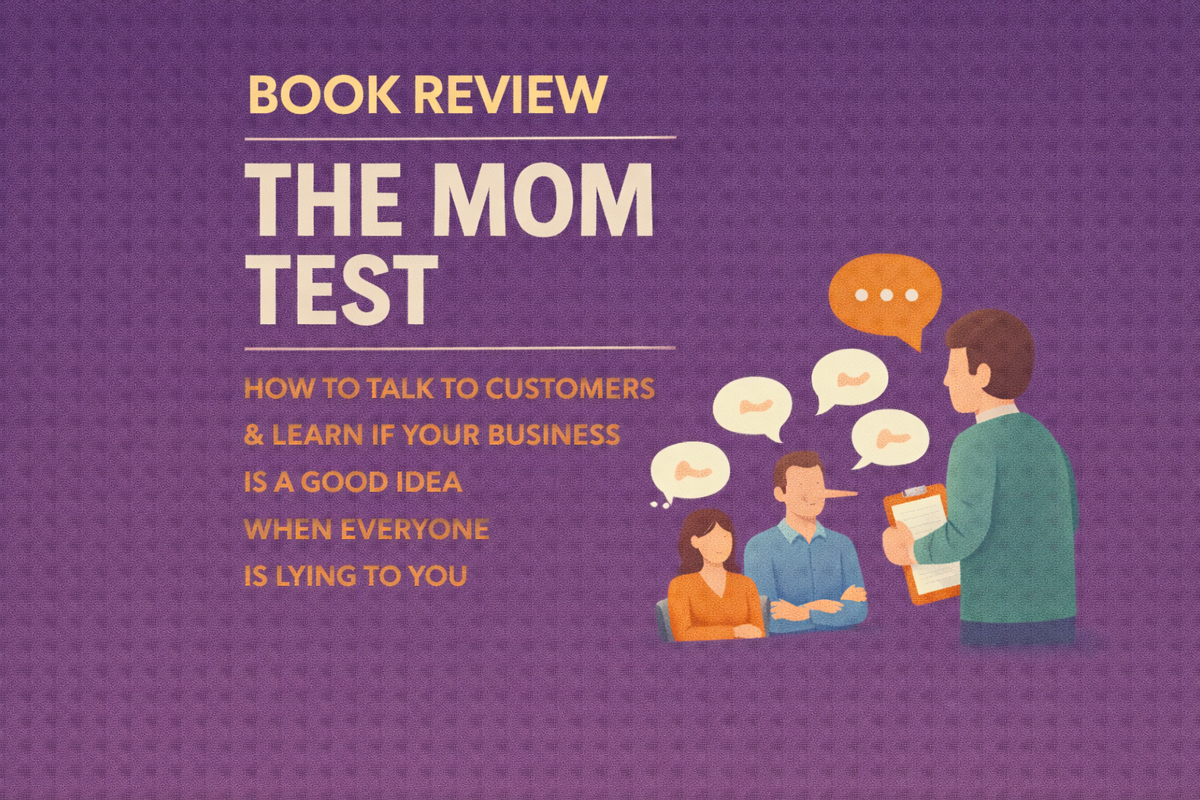
Rob Fitzpatrick's The Mom Test is built around a single devastating observation: most customer conversations tell you almost nothing useful, because most people are too polite to tell you your idea is bad. Your mum will not tell you your startup idea is terrible. Your potential customers will not tell you either - at least not directly, not honestly, and not in a way you will naturally interpret correctly.
The book's solution is a set of rules for having customer conversations that are actually informative - conversations structured around facts and past behaviours rather than opinions and future intentions. It is short, practical, and more useful per page than almost anything else written on the subject of customer discovery.
Customer research is one of the most consistently cited practices in product management and one of the most consistently done badly. Teams conduct interviews that confirm what they already believe. They ask leading questions and receive validating answers. They interpret enthusiasm for curiosity as evidence of willingness to pay. They return from customer sessions certain they have found product-market fit, and six months later wonder why nobody uses what they built.
The Mom Test is a corrective to the most common ways that customer conversations go wrong. For product managers, engineers, and founders who want to actually learn from their customers rather than simply talk to them, it provides the specific technique needed to make that distinction.
The core diagnosis is that most customer questions are bad - not because the people asking them are bad at research, but because the questions are structured in a way that makes honest negative feedback socially awkward. "Would you use a product that did X?" "Do you think this is a good idea?" "How would you feel about paying Y for this?" These questions invite optimism and are allergic to truth.
The rule Fitzpatrick introduces is simple: never ask anyone's opinion about your idea. Ask about their life, their problem, and their past behaviour. Opinions are cheap, unreliable, and systematically biased toward the positive when the person you are talking to has any interest in your feelings. Past behaviour is evidence.
The Mom Test reduces to three rules. Talk about their life, not your idea. Ask about specifics, not hypotheticals. Listen more than you speak.
The second rule is the most frequently violated. "Would you ever pay for this?" is a hypothetical. "Walk me through the last time this problem came up for you" is specific. The hypothetical produces speculation. The specific produces a story - and stories contain the real information: what the person actually did, what they tried, what they paid for, how much it cost them, and whether they solved the problem or gave up. A single specific story from a real customer is worth more than a hundred opinions.
Fitzpatrick introduces a distinction that most customer researchers miss: the difference between a conversation that ended with enthusiasm and a conversation that ended with commitment. Enthusiasm is cheap. "This is great, I'd definitely use it" costs the customer nothing. Commitment - "I'll introduce you to our head of procurement," "here's the pilot budget," "I'll sign up today" - costs something real.
A conversation that produces enthusiasm and no commitment has produced no validation. The product team leaves feeling good. Nothing has changed about the risk they are carrying. A conversation that produces a concrete next step - a follow-on meeting, an introduction, a letter of intent, a pre-purchase - has reduced the uncertainty in a way that enthusiasm alone cannot.
The most counterintuitive principle in the book is that a good customer conversation will regularly produce bad news - and that this is evidence the conversation is working. The questions that surface "this is not actually a problem for me," "we already solved this with a spreadsheet," and "I wouldn't pay more than fifty dollars for this" are the most valuable questions you can ask, because they prevent investment in the wrong direction.
The researcher's job is to uncover the truth about whether a problem exists, how painful it is, and whether the proposed solution is compelling - not to convince the customer that the problem is real and the solution is great. The best customer conversations feel like intelligence gathering, not selling. The moment you start defending your idea in a customer conversation, you have stopped learning.
The final section of the book addresses the practical problem that many teams ignore until it is too late: how to find the right customers to talk to, and how to conduct enough conversations to produce reliable signal rather than noise.
Fitzpatrick's guidance is direct: go to where your customers are, not where it is easy to get meetings. Use warm introductions. Aim for conversations with people who have the problem acutely, not people who might have it theoretically. And treat each conversation not just as a source of information but as a potential referral to the next conversation - "Who else do you know who struggles with this?" is one of the most valuable questions you can ask at the end of any customer session.
Count the questions in your last customer interview that asked for an opinion. Now count the questions that asked about a specific past behaviour or decision. If the ratio favours opinions, you learned less than you think you did.
"People said they would use it" is not validation. "People pre-signed up and gave us a credit card" is validation. The gap between these two statements is the gap between research that feels good and research that reduces risk.
The customer who will tell you your idea is bad is the most valuable person you will speak to this quarter. Are your interview questions structured to surface them, or to avoid them?
Your biggest competitor is the status quo, not the nearest analogous product. Every customer you interview who says "we just use spreadsheets" is telling you the real threshold your product needs to clear. Very few teams actually design against that threshold.
The best time to conduct customer research is before you write a single line of code. The second best time is right now, whatever stage you are at. The conversation that saves you six months of wasted development is always available. Most teams just choose not to have it.
Rewrite your three most important customer research questions. Remove any question that asks for an opinion, a prediction about future behaviour, or a reaction to your idea. Replace each one with a question about specific past behaviour: "Tell me about the last time...", "Walk me through how you currently...", "What did you do when...?"
Set up five customer conversations this month. Not surveys. Not focus groups. One-to-one conversations with people who have the problem you are trying to solve. Use warm introductions wherever possible.
Add a commitment question to the end of every customer conversation. "What would the next step be if you wanted to take this forward?" or "Is there someone on your team I should speak with?" A conversation that ends without any form of commitment has produced no validation.
Take notes on paper during customer conversations. Do not type - it changes the dynamic and your attention. Write down exact quotes, specific numbers mentioned, and observable signals. Review your notes immediately after and mark the three most important things you heard.
Debrief with your team after each research session. What specifically did you learn? Did anything challenge your current assumptions? What would you build differently if you had heard only this conversation? The value of research compounds when it is shared and acted upon rather than filed.
"The Mom Test: Talk about their life instead of your idea. Ask about specifics in the past instead of generics or opinions about the future. Talk less and listen more."
- Rob Fitzpatrick